%20(1).png/:/cr=t:0%25,l:0%25,w:100%25,h:100%25/rs=w:1209,h:605)

Keynote Speaker - Maree Crabbe
Eroticising Inequality: Pornography, young people and sexuality
Pornography has become a default sex educator for many young people, with serious implications for their capacity to negotiate free and full consent, for mutual respect, sexual health, and gender equality. There is growing concern internationally that pornography is contributing to cultural conditions that cultivate sexual assault.
Maree Crabbe is Director of the Australian violence prevention initiative, It’s time we talked. She is an educator, author, researcher and filmmaker who is passionate about gender-based violence prevention, and about supporting parents, schools, communities and government to address pornography’s influence on young people.
Keynote Speaker - Emily Colgan
She/Her
The Bible's Bloody Case Files: Gendered Violence and Biblical Texts
Emily Colgan is a Pākehā/palagi researcher in biblical studies from Aotearoa New Zealand. She lives in Tāmaki Makaurau (Auckland) and works at Trinity Theological College as the Academic Director and Associate Professor of Biblical Studies (Hebrew Bible). Her research focuses on the relationship between the Bible and contemporary social imaginaries, exploring the ways in which ideologies within biblical texts continue to inform communities in the present. Emily is particularly interested in ecological representations in the Bible, as well as depictions of gender and violence. She is the author of Jeremiah: An Earth Bible Commentary (forthcoming) and co-editor of The Routledge Companion to Eve (2024) and the multi-volume work, Rape Culture, Gender Violence, and Religion (2018). Emily is co-host of The Bloody Bible Podcast and co-director of The Shiloh Project.
Plenary Speakers

Sarah Wendt
Farjana Mahbuba
Farjana Mahbuba
She/Her
Professor of Social Work at Melbourne University
Farjana Mahbuba
Farjana Mahbuba
Farjana Mahbuba
She/Her
Researcher, Australian Catholic University
Naomi Wolfe
Farjana Mahbuba
Timothy Jones
She/Her
Trawlwoolway Aboriginal woman & lecturer in history & theology at ACU
Timothy Jones
Farjana Mahbuba
Timothy Jones
He/They
Associate Professor, History, at LaTrobe University
Charissa Suli
Geoff Thompson
Geoff Thompson
She/Her
President of the Uniting Church in Australia
Geoff Thompson
Geoff Thompson
Geoff Thompson
He/Him
Rev. Associate Professor of Theology
Steff Fenton
Geoff Thompson
Safina Stewart
They/Them
Genderqueer speaker, writer, and pastor
Safina Stewart
Geoff Thompson
Safina Stewart
She/Her
Storyteller and Aboriginal and Torres Strait Islander Lead at Common Grace
Ruth Powell
Monica Melanchthon
Monica Melanchthon
She/Her
Executive Director at NCLS Research, Adjunct Associate Professor at Charles Sturt University
Monica Melanchthon
Monica Melanchthon
Monica Melanchthon
She/Her
Associate Professor of Hebrew Bible at Pilgrim Theological College
Rachel Kronberger
Monica Melanchthon
Rachel Kronberger
She/Her
Uniting Church minister at Wesley Church, Melbourne
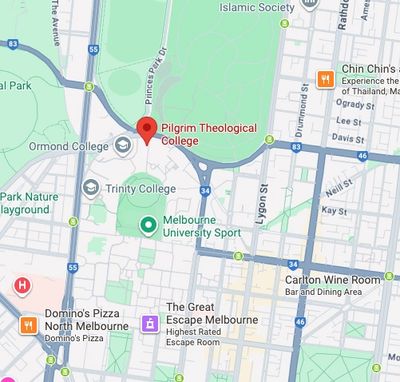
Venue - Pilgrim Theological College
29 College Crescent, Parkville
The venue is fully wheelchair accessible with bathrooms on the ground floor. There is also a cafe on site (Sage and Grace) open from 8.30am an serving great coffee, lunch, and snacks until about 3pm.
GETTING HERE...
BY PUBLIC TRANSPORT:
The no. 19 tram up Royal Parade is the closest tram stop, connecting with the CBD's Flinders St and Melbourne Central train stations. Get off at the Gatehouse St corner.
You can also come up Swanston St on the east side of the University of Melbourne, getting off at the University tram stop and walking up through campus. Trams that service that stop include 1, 3, 5, 6, 16, 67, 72.
BY CAR:
Parking is available on nearby streets and is metered. Given it is not semester yet street parking should be attainable but is never guaranteed.